
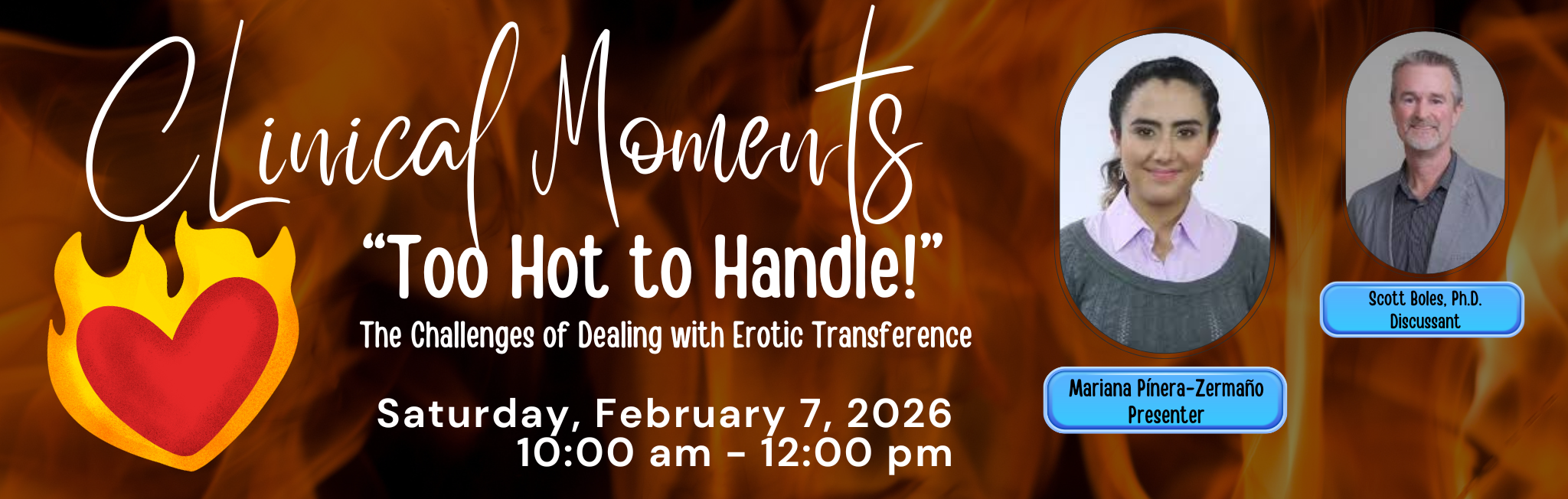
Clinical Moments is an in-person-only monthly series that explores pivotal moments in ongoing analytic treatments. Each session features a case presentation by a different analyst, focusing on a clinical moment that provides clinicians with an opportunity to think psychoanalytically about the material and deepen their understanding through shared insights. Whether you're seeking to refine your clinical skills or broaden your understanding of psychoanalytic work, Clinical Moments provides a rich forum for learning and professional growth.
February's Theme: Too Hot to Handle: The Challenges of Dealing with Erotic Transference
Join us for a compelling 90-minute program in which Mariana Zermeño Piñera, M.A., presents a clinical case centered on the challenges of dealing with erotic transference, followed by a discussion with Senior Analyst, Scott Boles, Ph.D. who will reflect on the analyst’s process and the ways one listens, responds, and holds the unfolding emotional experience of the treatment when intense longings are present.
Working inside the transference is a hallmark of psychoanalytic work; this is how the unconscious manifests feelings, desires, and expectations from significant past relationships. It sounds good in theory but when transference comes alive in the room, it can become very "real" for the therapist too, who has to be able to feel it and then use it in a meaningful way in the session.
This presentation invites participants the opportunity to consider the unique challenges the analyst has when dealing with their own erotic countertransference without pulling away from the fire.
*Join us at 9:30 am for a continental breakfast and coffee reception with the presenters.
Registration/Attendance Process: This is an in-person event, and registration is required.By registering for this event, all participants agree to abide by SDPC’s in-person and online meeting policies, including confidentiality, ethical conduct, and respectful participation. Failure to follow these guidelines may result in removal from the event and may be subject to disciplinary and/or legal action.
- Register by clicking the registration button. You will receive a confirmation by email with details about the event.
- Verify attendance by signing in on the attendance sheet at the event.
- Partial attendance at a CE/CME activity will not be awarded CE/CME credit.
Accommodations & Grievances: If you need special accommodations to attend this event, please contact the Event Coordinator.
For any grievances or issues, please contact the Continuing Education Manager.
When
Where
CEUs
Cost
Educational Objective(s)
- Distinguish between normal affection, erotic transference, and eroticized transference in the clinical encounter.
- Analyze moment-to-moment clinical process with attention to unconscious communication.
- Offer and receive collegial feedback on psychodynamic case material in a reflective and nondefensive manner.
- To distinguish between supportive measures, interpretations, and the use of the actual therapist-patient relationship in clinical intervention, and when each might be most optimally applied at a given moment in treatment.
- Recognise, understand, and manage one countertransference to erotic transference.
Presenter Information
Mariana Zermeño Piñera, M.A. (Presenter)
Mariana is a Clinical Psychologist in Tijuana. She studied Psychology at UABC in Tijuana, México, and completed a Master's degree at Universidad Complutense de Madrid. She is dedicated to her clinical practice in Tijuana, working with teenagers and adults who speak English and Spanish. She has researched subjects like fairytales, psychoanalysis, and psychosomatic disorders. She was a Ted Talk speaker in Tijuana talking about her experience processing loss through storytelling. She is a recent graduate of the San Diego Psychoanalytic Institute. She is a Candidate Representative at the DPE Steering Committee.
Scott Boles, Ph.D. (Discussant)
Dr. Boles is a Clinical Psychologist and Psychoanalyst in private practice who works with children, adolescents, adults, and couples, as well as provides individual and group supervision to mental health professionals. He serves on SDPC’s Education Committee and is a distinguished member of the faculty.
CONTINUING PROFESSIONAL EDUCATION ACCREDITATION
The San Diego Psychoanalytic Center (SDPC), is proud to offer CME credit to Physicians, Nurse Practitioners, Psychologists and Social Workers. These CME credits will usually satisfy requirements for Social Worker and Psychologist CEUs. However, clinicians should consult their state licensing boards for final approval. Please see the CE/CME credits page for more information.
Continuing Education certificates of attendance will be awarded electronically in exchange for a completed evaluation form. For refund policies or cancellations, please visit our policies page. Any other questions, contact the SDPC Continuing Education Manager.
 |
CMA Accreditation Statement: The San Diego Psychoanalytic Center is accredited by the California Medical Association (CMA, provider #4001214) to provide continuing medical education for physicians. |
AMA Credit Designation Statement: The San Diego Psychoanalytic Center designates this Continuing Education activity for a maximum of 2 hours AMA PRA Category 1 Credit(s)™️. Physicians should claim only the credit commensurate with the extent of their participation in the activity.
CAMFT Accreditation: The San Diego Psychoanalytic Center (SDPC) is approved by the California Association of Marriage and Family Therapists (CAMFT) as a continuing education provider, (#050121), to offer Category 1 credit for LMFT’S, LCSW’S, LPCC’S and LEP’S. SDPC as required by the California Board of Behavior Sciences. SDPC maintains responsibility for this course program and all of its content.
Psychologists: SDPC is also approved as a Continuing Education Provider by the California Board of Behavioral Sciences, Provider number PCE#794, to offer Category 1 credit for LCSWs, MFTs, and Registered Nurses, Provider Numbers CEP#4940. The California Board of Psychology accepts the Category 1 CE credits from the CMA. Acceptance of the CE credits for this activity is at the discretion of the licensing board. Psychologists are responsible for reporting their individual attendance to the Board of Psychology. All attendees are responsible for keeping their certificate of attendance for personal records.
IMPORTANT DISCLOSURE INFORMATION FOR ALL LEARNERS: None of the planners and presenters of this CME program has any relevant financial relationships to disclose.
The San Diego Psychoanalytic Center (SDPC) CME Committee has reviewed the materials for accredited continuing education and has determined that none of the planners and presenters for this activity have relevant financial relationship(s)* to disclose with ineligible companies whose primary business is producing, marketing, selling, re-selling or distributing healthcare products used by or on patients. This activity is not related to the product line of ineligible companies and therefore, the activity meets the exception outlined in Standard 3: ACCME's identification, mitigation, and disclosure of relevant financial relationships. This activity does not have any known commercial support.
*Financial relationships are relevant if the educational content that an individual can control is related to the business lines or products of the ineligible company.
Statement of Commitment: San Diego Psychoanalytic Center does not discriminate in employment and in its educational programs and activities, including admission or access thereto, on the basis of race, national origin, color, creed, religion, sex, age, marital status, disability, veteran status, sexual orientation, and gender identity.
----------------------------------------------------------------------------------------------------------
The San Diego Psychoanalytic Center is affiliated with the American Psychoanalytic Association (APsA), the International Psychoanalytic Association (IPA), and the organization of Southern California Psychoanalytic Institutes and Societies.
The San Diego Psychoanalytic Center is a 501(c)(3) nonprofit organization.