
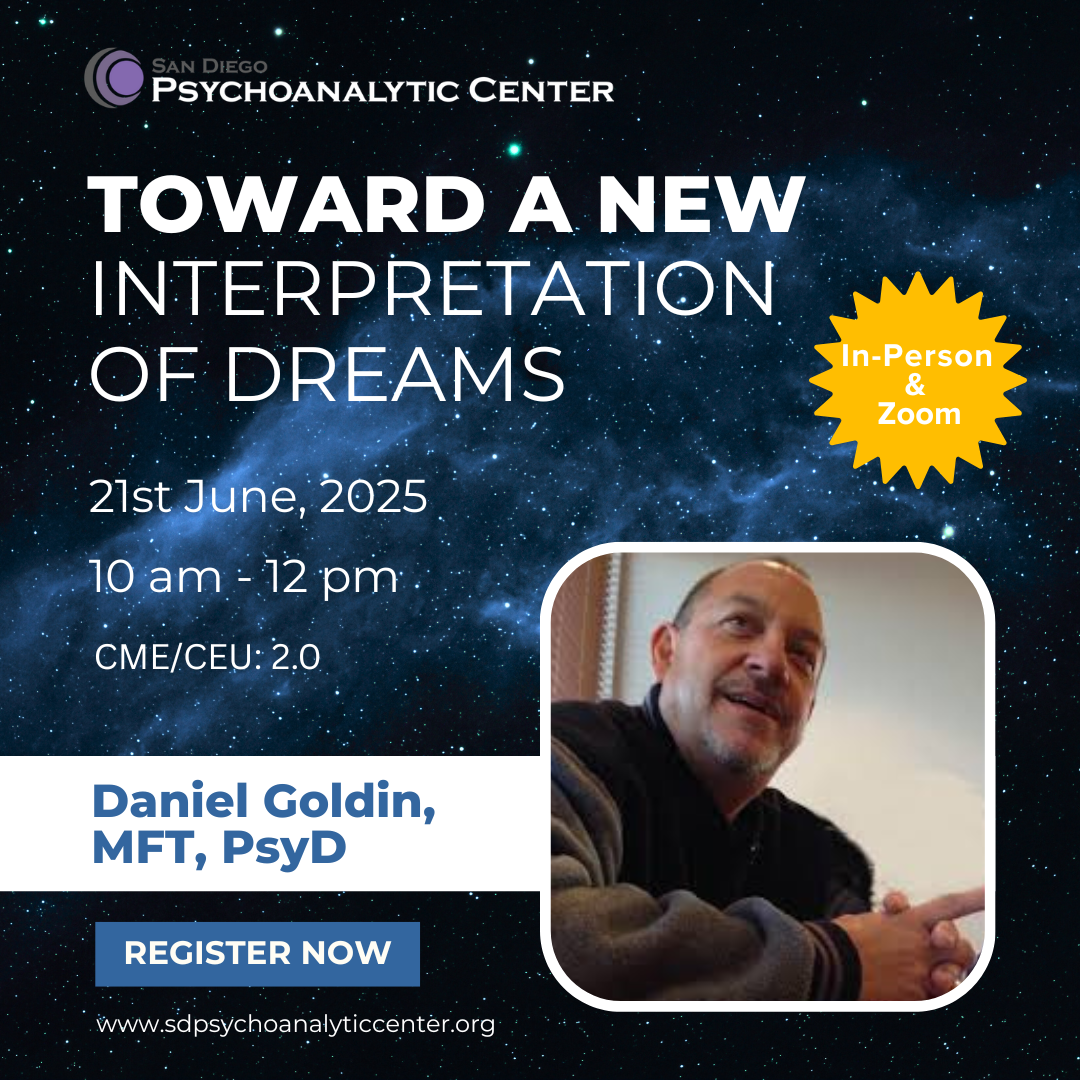
Description: Humans have always sought to find meaning in dreams. These strange absurdist parables that take shape in an infinite virtual space behind our eyes, when we lose control of our limbs and lose contact with our senses, seemed at one time to be coded communications from God or at the least intimations of what is to come. Dreams tell us things we don’t know. Their elements are symbolic, and we know that symbols point elsewhere and have a purpose.
Dr. Goldin believes that dreams return us to a state akin to that of our pre-verbal ancestors, who communicated in what Tomasello calls a "natural language" of imaginative pretense. The prelinguistic human was able to enact stories to reproduce situations in order to warn, explain or entertain, and then to apply those little dramas metaphorically to other situations. Lakoff argues that these basic embodied metaphors underlie our "civilized" verbal communication as well, although we are often unaware of the original storied sources of our abstract ideas. Dreams bring us back into contact with that original imagery. They send us into an immersive virtual world, a seemingly mind-independent "reality," in which the stories behind our ordinary language -- ancient, cultural and personal -- take concrete shape around an active protagonist adapting to a metaphoric world generated by their own mind. By acting within these condensed fictional parables, we are able to evolve the narrative schemas or storylines behind our current problems in living.
Registration/Attendance Process: This is an online event and preregistration is required.;By registering for this event, all participants agree to abide by SDPC’s in-person and online meeting policies, including confidentiality, ethical conduct, and respectful participation. Failure to follow these guidelines may result in removal from the event and may be subject to disciplinary and/or legal action.
- Register by clicking the registration button. You will receive a confirmation by email with details about the event.
- We will have a list of registrants and will check your attendance.
- Participants must list full name under your video image to allow the Continuing Education Manager to confirm your attendance.
- Participants must have their cameras on at the beginning and the end of the event to receive credit.
- Partial attendance of a CE/CME activity will not be awarded CE/CME credit.
Accommodations & Grievances
- If you need special accommodations to attend this event, please contact the Event Coordinator.
- For any grievances or issues, please contact the Continuing Education Manager for any grievances.
Please note: This event may be recorded for educational purposes. Participants are requested to have their cameras on for CME credit. If you do not wish to be recorded, please be aware that your image and voice may be captured as part of the event.
When
Zoom meeting
By registering for this event, all participants agree to abide by SDPC’s in-person and online meeting policies, including confidentiality, ethical conduct, and respectful participation. Failure to follow these guidelines may result in removal from the event and may be subject to disciplinary and/or legal action.
Questions contact
CEUs
Educational Objective(s)
- Identify narrative schemas or storylines undergirding a patient’s narrative.
- Consider how a patient’s dreams enact problems in living, in a fictional form, in order to evolve the intransigent storylines behind them.
- Develop strategies for listening for metaphors in a patient’s presentation and working “within the metaphor
Presenter Information
Bio: Dr. Goldin is a licensed therapist and psychoanalyst with offices in South Pasadena. He specializes in psychotherapy for adults, adolescents, families, and couples. In addition, He runs psychotherapy process groups and groups for addicts in recovery.
Dr. Goldin has written for The International Journal of Psychoanalytic Self-Psychology, Psychoanalytic Dialogues, and Psychoanalytic Inquiry. He is an associate editor for Psychoanalytic Inquiry and an associate book editor for Psychoanlaysis: Self in Context.
Continuing Professional Education Accreditation
The San Diego Psychoanalytic Center (SDPC), is proud to offer CME credit to Physicians, Nurse Practitioners, Psychologists and Social Workers. These CME credits will usually satisfy requirements for Social Worker and Psychologist CEUs. However, clinicians should consult their state licensing boards for final approval. Please see the CE/CME credits page for more information.
Continuing Education certificates of attendance will be awarded electronically in exchange for a completed evaluation form. For refund policies or cancellations, please visit our policies page. Any other questions, contact the SDPC Continuing Education Manager.
 |
CMA Accreditation Statement: The San Diego Psychoanalytic Center is accredited by the California Medical Association (CMA, provider #4001214) to provide continuing medical education for physicians. |
AMA Credit Designation Statement: The San Diego Psychoanalytic Center designates this Continuing Education activity for a maximum of 2 hours AMA PRA Category 1 Credit(s)™️. Physicians should claim only the credit commensurate with the extent of their participation in the activity.
CAMFT Accreditation: The San Diego Psychoanalytic Center (SDPC) is approved by the California Association of Marriage and Family Therapists (CAMFT) as a continuing education provider, (#050121), to offer Category 1 credit for LMFT’S, LCSW’S, LPCC’S and LEP’S. SDPC as required by the California Board of Behavior Sciences. SDPC maintains responsibility for this course program and all of its content.
Psychologists: SDPC is also approved as a Continuing Education Provider by the California Board of Behavioral Sciences, Provider number PCE#794, to offer Category 1 credit for LCSWs, MFTs, and Registered Nurses, Provider Numbers CEP#4940. The California Board of Psychology accepts the Category 1 CE credits from the CMA. Acceptance of the CE credits for this activity is at the discretion of the licensing board. Psychologists are responsible for reporting their individual attendance to the Board of Psychology. All attendees are responsible for keeping their certificate of attendance for personal records.
IMPORTANT DISCLOSURE INFORMATION FOR ALL LEARNERS: None of the planners and presenters of this CME program has any relevant financial relationships to disclose.
The San Diego Psychoanalytic Center (SDPC) CME Committee has reviewed the materials for accredited continuing education and has determined that none of the planners and presenters for this activity have relevant financial relationship(s)* to disclose with ineligible companies whose primary business is producing, marketing, selling, re-selling or distributing healthcare products used by or on patients. This activity is not related to the product line of ineligible companies and therefore, the activity meets the exception outlined in Standard 3: ACCME's identification, mitigation, and disclosure of relevant financial relationships. This activity does not have any known commercial support.
*Financial relationships are relevant if the educational content that an individual can control is related to the business lines or products of the ineligible company.
Statement of Commitment: San Diego Psychoanalytic Center does not discriminate in employment and in its educational programs and activities, including admission or access thereto, on the basis of race, national origin, color, creed, religion, sex, age, marital status, disability, veteran status, sexual orientation, and gender identity.
----------------------------------------------------------------------------------------------------------
The San Diego Psychoanalytic Center is affiliated with the American Psychoanalytic Association (APsA), the International Psychoanalytic Association (IPA), and the organization of Southern California Psychoanalytic Institutes and Societies.
The San Diego Psychoanalytic Center is a 501(c)(3) nonprofit organization.