
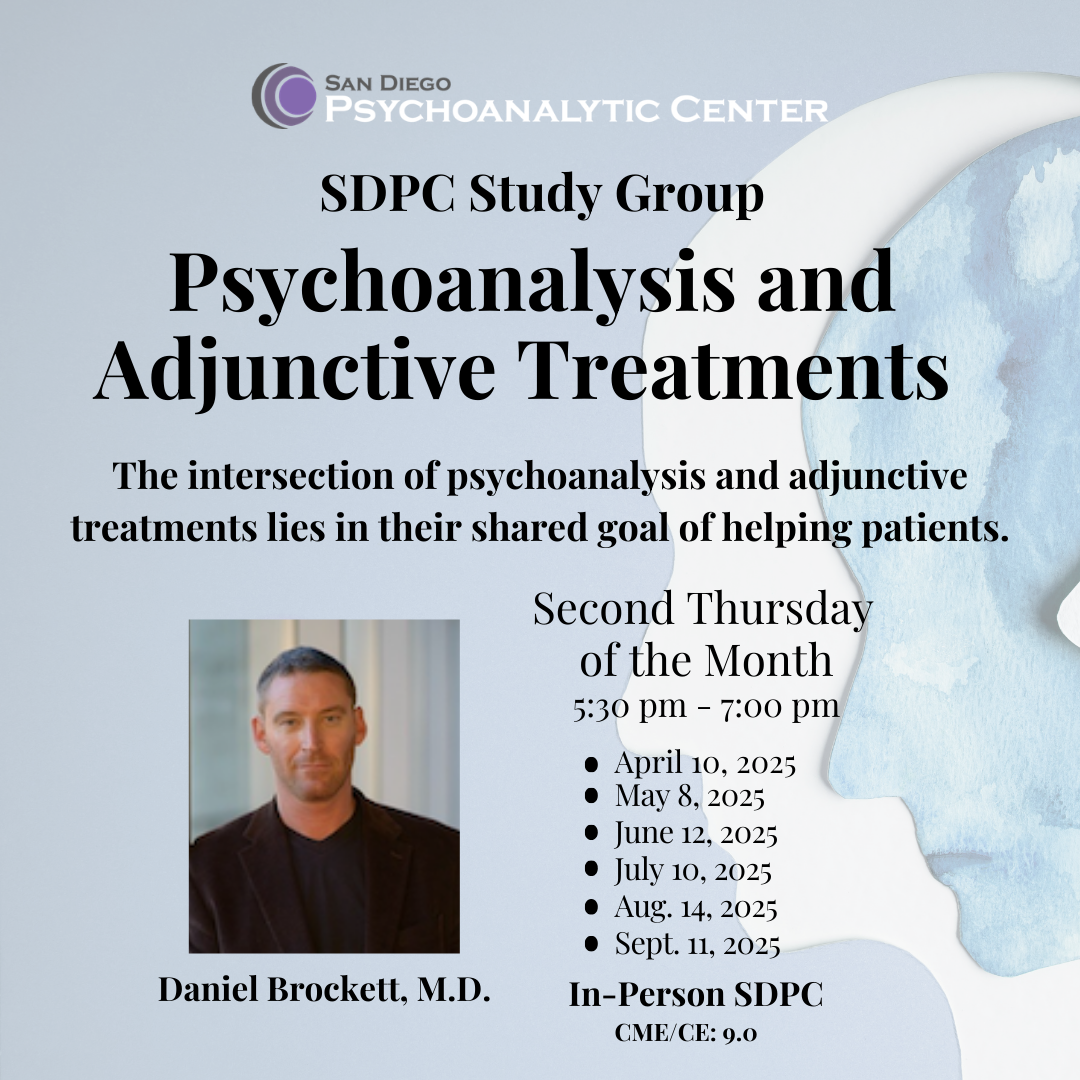
Event Description: As the exploration of adjunctive treatments for psychological disorders gains momentum, it becomes crucial for therapists to develop an in-depth understanding of these approaches. Our patients will inevitably approach us to discuss their experiences with such treatments, and some of us may find them useful in assisting psychotherapy with certain individuals. Rather than sharing the same aim, psychoanalysis and adjunctive treatments are distinct: psychoanalysis investigates unconscious meaning within a relational frame, while adjunctive treatments can transiently alter affect, cognition, and learning to facilitate the analytic process.
Psychoanalysis is a therapeutic technique that involves exploring the unconscious mind. Psychoanalytic treatment is based on bringing unconscious thoughts and feelings to conscious awareness, leading to insight and healing. The psychoanalytic process relies on a dialogue between the patient and the therapist, experientially embedded in that relationship, leading to the resolution of psychological conflicts. Adjunctive treatments refer to interventions used to target symptoms, enhance the therapeutic benefit of treatments, or address comorbid conditions. In recent years, there has been growing interest in the potential therapeutic use of adjunctive treatments for conditions such as depression, anxiety, PTSD, addiction, and end-of-life distress. Both contemporary research and research dating back decades suggest that, under controlled conditions and with appropriate therapeutic support, these approaches may facilitate profound psychological insights and lasting change. The intersection of psychoanalysis and adjunctive treatments lies in their shared goal of helping patients.
2nd Thursday of the month: Starts April. 10, 2025
5:30 pm - 7:00 pm
2025: 4/10/25, 5/5/25, 6/12/25, 7/10/25, 8/14/25. & 9/11/25
Target Audience: This discussion group is intended for mental health professionals and open to the public interested in psychoanalytic perspectives. Open to members and the community.
Registration/Attendance Process: This is an in-person event, and preregistration is required. By registering for this event, all participants agree to abide by SDPC’s in-person and online meeting policies, including confidentiality, ethical conduct, and respectful participation. Failure to follow these guidelines may result in removal from the event and may be subject to disciplinary and/or legal action.
- Register by clicking the registration button. You will receive a confirmation by email with details about the event.
- We will have a list of registrants and will check you off. You may also pay at the door. Preregistration is preferred.
- Note: partial attendance of a CE/CME activity will not be awarded CE/CME credit
Accommodations & Grievances:
- If you need special accommodations to attend this event, please contact the Event Coordinator.
- For any grievances or issues, please contact our manager.
When
Where
SDPC
In Person, SDPC Offices
CEUs
Cost
Educational Objective(s)
- Compare different models of adjunctive treatment to assisted psychotherapy
- Explain the neuropsychopharmacology of emerging classes of medications.
- Identify hypotheses for mechanisms of action of adjunctive treatments on the brain.
- Understand the challenges of integrating adjunctive treatment experiences into psychotherapy.
- Understand how neuroscience concepts, such as memory reconsolidation, predictive encoding, and updating working memory, relate to the clinical concepts of transference analysis and working through.
- Understand how the neuroscience concept of the Default Mode Network (DMN) relates to the clinical concepts of the narrative self through fantasy and phantasy.
- Assess potential applications of adjunctive treatments to assist psychotherapy, including extra-psychiatric fields (such as palliative care and spirituality) as well as within medicine (such as for pain and immunomodulation).
Presenter Information
Daniel Brockett, M.D.
Dr. Brockett has devoted much of his career to Psychoanalysis and Psychotherapy after receiving training in Internal Medicine, Psychiatry, and Psychoanalysis. His undergraduate education was at the University of California at San Diego, where he graduated Summa Cum Laude and Phi Beta Kappa. He studied Medicine at the University of California at Irvine. Dr. Brockett is a faculty member at the San Diego Psychoanalytic Center and a voluntary assistant clinical professor at the University of California, San Diego. He teaches at both institutions.
CONTINUING PROFESSIONAL EDUCATION ACCREDITATION
The San Diego Psychoanalytic Center (SDPC), is proud to offer CME credit to Physicians, Nurse Practitioners, Psychologists and Social Workers. These CME credits will usually satisfy requirements for Social Worker and Psychologist CEUs. However, clinicians should consult their state licensing boards for final approval. Please see the CE/CME credits page for more information.
Continuing Education certificates of attendance will be awarded electronically in exchange for a completed evaluation form. For refund policies or cancellations, please visit our policies page. Any other questions, contact the SDPC Continuing Education Manager.
 |
CMA Accreditation Statement: The San Diego Psychoanalytic Center is accredited by the California Medical Association (CMA, provider #4001214) to provide continuing medical education for physicians. |
AMA Credit Designation Statement: The San Diego Psychoanalytic Center designates this Continuing Education activity for a maximum of 9 hours AMA PRA Category 1 Credit(s)™️. Physicians should claim only the credit commensurate with the extent of their participation in the activity.
CAMFT Accreditation: The San Diego Psychoanalytic Center (SDPC) is approved by the California Association of Marriage and Family Therapists (CAMFT) as a continuing education provider, (#050121), to offer Category 1 credit for LMFT’S, LCSW’S, LPCC’S and LEP’S. SDPC as required by the California Board of Behavior Sciences. SDPC maintains responsibility for this course program and all of its content.
Psychologists: SDPC is also approved as a Continuing Education Provider by the California Board of Behavioral Sciences, Provider number PCE#794, to offer Category 1 credit for LCSWs, MFTs, and Registered Nurses, Provider Numbers CEP#4940. The California Board of Psychology accepts the Category 1 CE credits from the CMA. Acceptance of the CE credits for this activity is at the discretion of the licensing board. Psychologists are responsible for reporting their individual attendance to the Board of Psychology. All attendees are responsible for keeping their certificate of attendance for personal records.
IMPORTANT DISCLOSURE INFORMATION FOR ALL LEARNERS: None of the planners and presenters of this CME program has any relevant financial relationships to disclose.
The San Diego Psychoanalytic Center (SDPC) CME Committee has reviewed the materials for accredited continuing education and has determined that none of the planners and presenters for this activity have relevant financial relationship(s)* to disclose with ineligible companies whose primary business is producing, marketing, selling, re-selling or distributing healthcare products used by or on patients. This activity is not related to the product line of ineligible companies and therefore, the activity meets the exception outlined in Standard 3: ACCME's identification, mitigation, and disclosure of relevant financial relationships. This activity does not have any known commercial support.
*Financial relationships are relevant if the educational content that an individual can control is related to the business lines or products of the ineligible company.
Statement of Commitment: San Diego Psychoanalytic Center does not discriminate in employment and in its educational programs and activities, including admission or access thereto, on the basis of race, national origin, color, creed, religion, sex, age, marital status, disability, veteran status, sexual orientation, and gender identity.
----------------------------------------------------------------------------------------------------------
The San Diego Psychoanalytic Center is affiliated with the American Psychoanalytic Association (APsA), the International Psychoanalytic Association (IPA), and the organization of Southern California Psychoanalytic Institutes and Societies.
The San Diego Psychoanalytic Center is a 501(c)(3) nonprofit organization.