
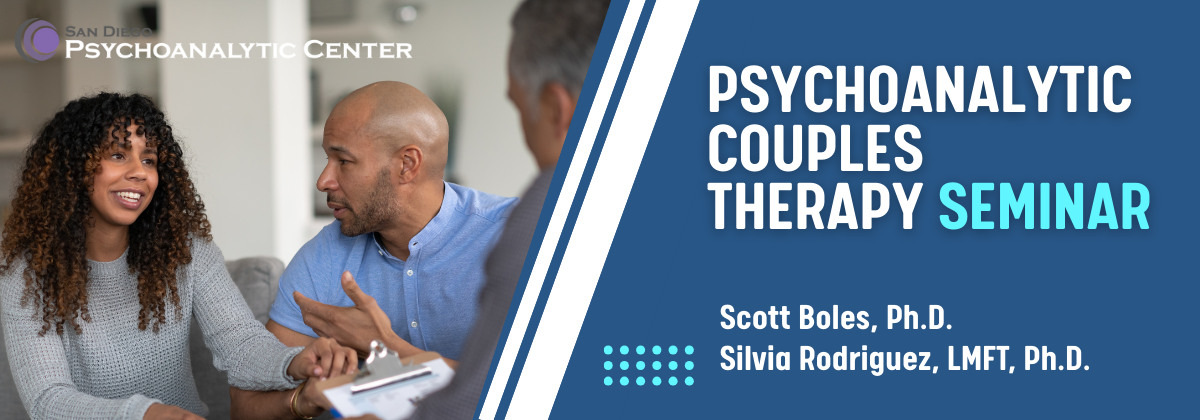
Teaching psychoanalytically informed couples therapy in seven classes is daunting, given that it typically demands the same amount of time, effort, and commitment as learning to perform psychotherapy and psychoanalysis well. Some might argue that working with a couple is even more difficult, as it involves working with the minds of two people rather than just one. Yet, through our class readings and discussions, we hope to enhance and broaden the ways you already work with couples and deepen your understanding of working within a psychoanalytically informed framework.
As many of you know, there is a range of approaches to couples therapy, such as Jill and David Scharff’s Object Relations approach, Philip Ringstrom’s Relational approach, and even the popular approach of John and Julie Gottman. However, given our limited time together, we plan to simplify and narrow our focus to a particular model and set of authors, one based on the Tavistock Relationships approach to treating couples. We will use this model to help provide a framework, foundation, and mindset for working psychoanalytically with couples.
Session Dates:
Second Wednesday of the month
7:00 pm - 8:30 pm
2025: Nov. 5, Dec 3
2026: Jan 7, Feb 4, Mar 4, Apr 1, May 6
Target Audience: This program meets the needs of all mental health professionals, including psychiatrists, psychiatric nurses, psychologists, social workers, and marriage and family therapists. All levels.
Seminar Format: This is an in-person only program and preregistration is required.
$350 Seminar Registration - General
$300 Seminar Registration - SDPC Members
Refund/Cancellation Policy:
Please note that SDPC only provides a credit, no cash refunds, on purchased tickets; event credit can be applied towards future events. See our website for our cancellation policy.
Registration/Attendance Process: By registering for this event, all participants agree to abide by the San Diego Psychoanalytic Center (SDPC) in-person meeting policies, including confidentiality, ethical conduct, and respectful participation. Failure to follow these guidelines may result in removal from the event and may be subject to disciplinary and/or legal action.
- Register by clicking the registration button. You will receive a confirmation by email with details about the event.
- We will have a list of registrants and will check you off. You may also pay at the door. Preregistration is preferred.
- Verify attendance by signing in on the attendance sheet at in-person events.
- Partial attendance at a CME/CE activity will not be awarded CME/CE credit.
Accommodations & Grievances
- If you need special accommodations to attend this event, please contact the Event Coordinator at events@sdpsychoanalytic.org.
- For any grievances or issues, please contact the Continuing Education Manager at cme@sdpsychoanalytic.org.
Certificates
- Continuing Education certificates of attendance will be awarded electronically upon completion of an evaluation form.
- To receive continuing education credit for this activity, participants must attend the entire program and complete the program evaluation. Credit cannot be awarded for partial attendance. Please speak to the instructor(s) regarding missed sessions.
- All attendees are responsible for keeping their certificate of attendance for personal records.
When
Where
CEUs
Cost
Educational Objective(s)
- Compare how psychoanalytic psychotherapy with individuals is similar and dissimilar from working psychoanalytically with couples in treatment.
- Identify clinical ideas, core concepts, or principles commonly associated with the Tavistock Relations approach to couple therapy.
- Explain how the Tavistock Relations model envisions the psychoanalytic process with couples and what it considers to be the source of its therapeutic action and change.
Presenter Information
Scott Boles, Ph.D.
Dr. Boles is a Clinical Psychologist and Psychoanalyst in private practice who works with children, adolescents, adults, and couples, as well as provides individual and group supervision to mental health professionals. He serves on SDPC’s Education Committee and is a distinguished member of the faculty.
Silvia Rodriguez, Ph.D., LMFT
Dr. Rodriguez is a Licensed Psychotherapist and Analyst who treats children, adolescents and adults. Dr. Rodriguez is also an experienced licensed therapist and marriage and family counselor with a private practice in San Diego. She is a graduate from SDPC’s psychoanalytic training program and now a member of the faculty.
Continuing Professional Education Accreditation
The San Diego Psychoanalytic Center (SDPC), is proud to offer CME credit to Physicians, Nurse Practitioners, Psychologists and Social Workers. These CME credits will usually satisfy requirements for Social Worker and Psychologist CEs. However, clinicians should consult their state licensing boards for final approval. Please see the CME/CE credits page for more information.
 |
CMA Accreditation Statement: The San Diego Psychoanalytic Center is accredited by the California Medical Association (CMA, provider #4001214) to provide continuing medical education for physicians. |
AMA Credit Designation Statement: The San Diego Psychoanalytic Center designates this Continuing Education activity for a maximum of 10.5 AMA PRA Category 1 Credit(s)™️. Physicians should claim only the credit commensurate with the extent of their participation in the activity.
 |
CAMFT Accreditation Statement: The San Diego Psychoanalytic Center (Provider #050121) is approved by the California Association of Marriage and Family Therapists (CAMFT) to sponsor continuing education for LMFTs, LCSWs, LPCCs, and LEPs for this activity. The San Diego Psychoanalytic Center maintains responsibility for this program/course and its content. |
BBS Statement: Course meets the qualifications for 10.5 hours of continuing education credit for LMFTs, LCSWs, LPCCs, and/or LEPs as required by the California Board of Behavioral Sciences. Partial credit will not be awarded.
Psychologists: The San Diego Psychoanalytic Center is also approved as a Continuing Education Provider by the California Board of Behavioral Sciences, Provider number PCE#794, to offer CE credit for LCSWs, MFTs, and Registered Nurses, Provider Number CEP#4940. The California Board of Psychology accepts CE credits from the CMA. Psychologists are responsible for reporting their individual attendance to the Board of Psychology.
IMPORTANT DISCLOSURE INFORMATION FOR ALL LEARNERS: None of the planners and presenters of this CME program has any relevant financial relationships to disclose.
The San Diego Psychoanalytic Center (SDPC) CME Committee has reviewed the materials for accredited continuing education and has determined that none of the planners and presenters for this activity have relevant financial relationship(s)* to disclose with ineligible companies whose primary business is producing, marketing, selling, re-selling or distributing healthcare products used by or on patients. This activity is not related to the product line of ineligible companies and therefore, the activity meets the exception outlined in Standard 3: ACCME's identification, mitigation, and disclosure of relevant financial relationships. This activity does not have any known commercial support.
*Financial relationships are relevant if the educational content that an individual can control is related to the business lines or products of the ineligible company.
Statement of Commitment: The San Diego Psychoanalytic Center does not discriminate in employment and in its educational programs and activities, including admission or access thereto, on the basis of race, national origin, color, creed, religion, sex, age, marital status, disability, veteran status, sexual orientation, and gender identity.
----------------------------------------------------------------------------------------------------------
The San Diego Psychoanalytic Center is affiliated with the American Psychoanalytic Association (APsA), the International Psychoanalytic Association (IPA), and the Organization of Southern California Psychoanalytic Institutes and Societies.
The San Diego Psychoanalytic Center is a 501(c)(3) nonprofit organization.